
No, I am not writing that headline because France has lost. As always, France had the talent to win, but counted too much on the supposed brilliance of their star players that never showed because Spain thwarted them. Spain was more aggressive on the ball and knew who to pressure (Olise) and how to control Mbappe and Dembele, because they have played them for years.
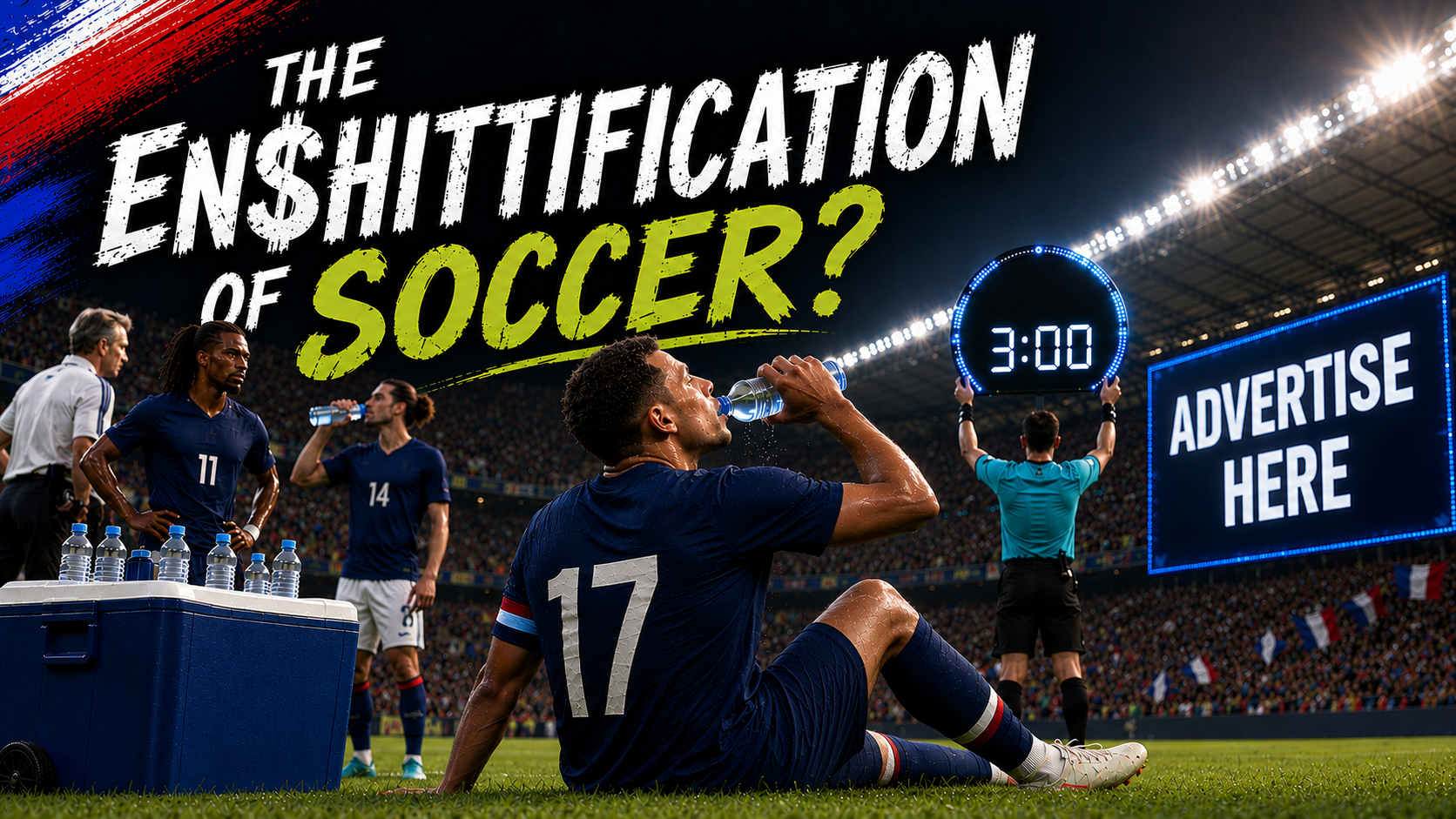
The headline refers to hydration breaks, or more specifically, their effects on the quality and economics of the sport.
The furor over high ticket prices, which I posted about last week, is not the only economic controversy created by the 2026 World Cup. Mandatory “hydration breaks,” a decision made by FIFA for this year’s tournament, may have long-term ramifications for the economics of soccer and forever change the fabric of the game itself.
Why pause the match?
Seen literally and narrowly, the hydration break is a health-and-safety issue. In the intense heat and humidity of venues located in Massachusetts, Philadelphia, and New York, players deserve an opportunity to manage their fluid and electrolyte levels. That is especially important in the knockout round when matches may include 30 minutes of extra time if tied after regulation.
But seen more broadly and cynically, the hydration break turns soccer into a game with quarters instead of halves, making the structure similar to American football or NBA basketball, when teams can use the breaks as timeouts to reset strategy. Networks, however, use those 3-minute interruptions to sell more advertisements, which is difficult to do in the flow of a typical soccer half.
Has the enshittification of soccer begun?
Earlier this week, several colleagues of mine published an excellent take on the future of the business of soccer. In their discussion, they viewed the game itself as a constant: “On the pitch, the game remains remarkably unchanged,” they wrote. “Nearly a century after the first World Cup, a match is still 90 minutes, 11 players a side, and a goal at each end.”
But what if those 90 minutes are now broken down into four quarters instead of two 45-minute halves? Many fans seem to think that is detrimental to the game because it interrupts the flow and artificially alters momentum. That leads us directly to the concept on “enshittification”.
Believe it or not, the popular term coined in 2022 by journalist Cory Doctorow, has some technical rigor. Enshittification describes a process of deterioration that occurs in two-sided markets with business customers and end users. When prioritization shifts away from end users, the quality of the product diminishes.
Applied to professional soccer, it means the quality of the game will deteriorate when governing organizations make moves that prioritize business customers (=money) over fan experience and satisfaction. We can then frame the question about the future of hydration breaks in this context: is it worth sacrificing the quality of the game if it makes media companies, and the soccer organizations that sell them their rights, better off?
The economics of hydration breaks
Should professional soccer institutionalize the quarter system and get rid of 45-minute running time halves?
As a pricing professional and a trained engineer, I love finding ways to quantify such questions. So, let’s view this as an elasticity challenge. We can quantify the additional revenue that a network such as FOX generates by selling ads during hydration breaks. We can also get some indication of whether fans see the breaks as positive, negative, or neutral. If we convert both into a percentage change, we can assess how difficult the decisions will be for FIFA and other league organizations to decide the future of “hydration breaks” or quarters.
In theory, a huge financial increase with minimal decline in fan satisfaction would make sense. Conversely, a slight change in revenue weighed against a large and persistent fan uproar makes little sense. The difficult decisions lie between those two extremes.
Right now, FOX stands to earn between $250 million and $600 million in incremental advertising revenue from hydration breaks. The network paid $450 million for the English-language broadcast rights. The money from hydration breaks alone could pay for the rights and leave FOX with a profit.
On the other side, two analyses showed that around 75% of fans have a negative view of hydration breaks. The Athletic polled readers just as the tournament began and found that 76% found the change “problematic.” Earlier this month, Reuters cited an analysis by PeakMetrics which found that “75% of online conversation surrounding hydration breaks was unfavourable.”
So if fans dislike it, why do it? Is the money enough to offset fan resistance? Unfortunately, without more data and context, I can only speak directionally to what an “enshittification elasticity” might reveal.
What happens over the long term?
That is the critical question. There is an element of fairness in play if fans see the hydration breaks more as a cynical money grab than an improvement to the game they love. The risk of enshittification also increases if fans become jaded and FIFA or other governing organizations make other changes to the fabric of the game itself.
If you don’t think that can happen – or that it can alienate fans – just ask an older college basketball fan what they think of the shot clock and the three-point shot. Neither existed until the mid-1980s. Or ask a baseball fan what they think of the designated hitter, the shift, interleague play, or the pitch clock. Or maybe ask a NASCAR fan what they think of breaking up each weekend’s race into stages instead of letting the cars run wide open.
Even soccer hasn’t remained entirely unchanged over the last 100 years. I am old enough to remember that soccer already bowed to the pressure of advertisers back when they made the half-time pause 15 minutes and sent the players back to the dressing rooms. When I grew up, rugby did not do that, and it was seen as the “true” team sport.
In 2026 and beyond, could the widespread adoption of hydration breaks (and thus, quarters instead of halves) leave fans wondering “what next?” along the slippery slope of enshittification?
One school of thought is that fans will someday take the hydration breaks for granted and teams will plan around them and look for an edge. Former US National Team player and current FOX analyst Alexi Lalas put it this way: “It benefits players and advertisers. Win/win. Yes, it changes how you play/coach/watch, but so did substitutions, 3 pts for win, VAR, etc. Evolve and adapt. There will be a generation whose version of the beautiful game includes quarters.”
What do you think? Should national federations also adopt hydration breaks or should the purists win the debate, even with hundreds of millions of dollars at stake? And who will win on Sunday? To be honest I trust Spain will have what it takes to keep the result and not lose in the last 10 minutes against Argentina.